

Where experience
drives learning.
An integrated full-day learning space for ages 5–6 designed around Project-Based Learning, Movement Through Martial Arts, Personalized Pathways, and Cultural Connection.
Based in Glendale, CA · Exact campus location coming soon

Kinetiq Learning is an integrated learning ecosystem combining project-based learning, movement through martial arts, personalized pathways, and cultural connection into one connected experience.
Designed around the child, not the system, Kinetiq nurtures confidence, curiosity, adaptability, and a lifelong love for learning during the most formative years of development.
Expansion to Pre-K and additional elementary grades is planned as Kinetiq grows.
The Four Pillars
An experience, not a curriculum.
Project-Based Learning
Hands-on, inquiry-driven experiences that turn curiosity into real-world problem solving.
Movement Through Martial Arts
Intentional movement that builds focus, confidence, resilience, and body awareness.
Personalized Pathways
Learning experiences shaped around each child's strengths, pacing, and growth.
Cultural Connection
Inquiry-led cultural experiences that nurture empathy, identity, and global perspective.
Inside the Experience
Children don't move through subjects.
They move through experiences.

At Kinetiq, learning happens through inquiry, real-world exploration, building, storytelling, movement, creativity and collaboration.
Creativity, experimentation, and expression are part of the everyday learning environment — not separate from it.
Why the Early Years Matter
Ages 5–6 shape how children think, feel, connect, and engage with the world.
We believe these years deserve intentional, integrated, and deeply meaningful learning experiences — not fragmented schedules.
5–6
ages we serve
4
connected pillars
1
ecosystem
The Science
Early childhood learning should be FunHands-on.
"Understanding is in our interactions with the environment. This is the core concept of constructivism."
Guided play outperforms direct instruction across key early childhood skills.
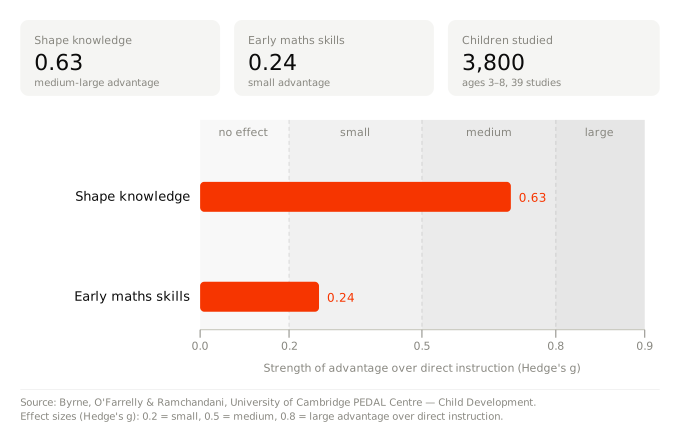
Numerous studies find guided play outperforms direct instruction for young children's learning. A recent meta-analysis of nearly 3,900 children, ages 1–8, found guided play significantly outperformed formal teaching across core tasks — early math (g ≈ 0.24), spatial and shape knowledge (g ≈ 0.63).
When lessons are embedded in playful activities, children learn those concepts more effectively than through drill-and-practice alone.
Source: University of Cambridge, Faculty of Education →Young children learn best in an interactive, relational mode rather than through an education model that focuses on rote instruction.
The Matthew Effect
At KinetIQ, excellence is achieved through experience — and it matters to start early.
You've probably heard of the Matthew Effect. Did you know it also applies to early education?
Children with larger vocabularies in elementary school tend to perform better on reading comprehension during those years. More importantly, research finds that vocabulary knowledge in the early elementary years predicts how quickly reading comprehension improves over time.
In other words, children who gain an early advantage in literacy often continue to progress more rapidly than their peers — a pattern where the rich get richer.
Reading Performance by Grade
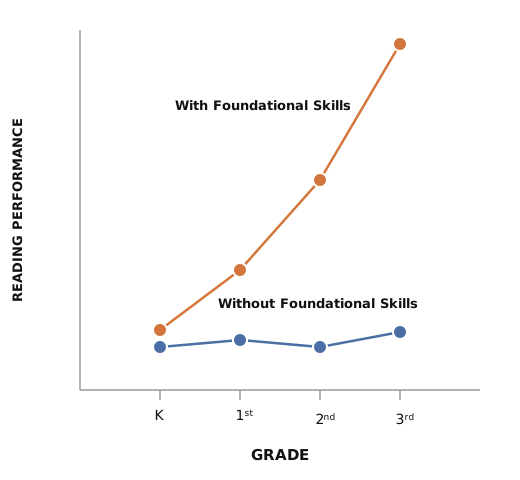
This widening-gap pattern holds true for many other dimensions of learning, not just reading.
Source: Stanovich, K. E. (2009). Matthew Effects in reading: Some consequences of individual differences in the acquisition of literacy. Journal of Education →Built by a multidisciplinary team
Community Preview
A learning environment and a growing community of education advocates.
From parent conversations and workshops to expert talks and experience days — Kinetiq is designed for connection.
View upcoming events
Reimagining the formative years of learning.
Join our growing community of families, educators, and collaborators shaping the future of early childhood education.
Start an inquiry